
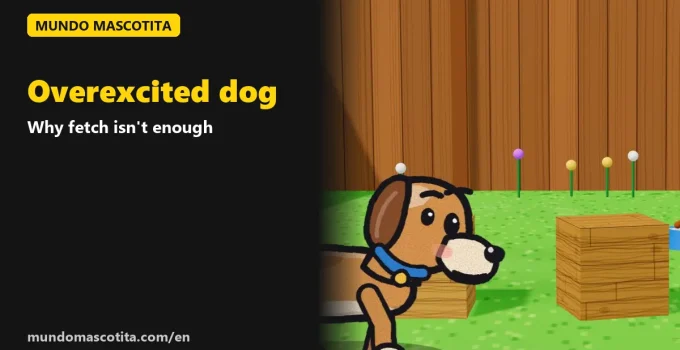
An overexcited dog usually doesn’t need more running. It needs work for its brain and more rest: sniffing and scent games tire the mind, while endless fetch mostly builds a fitter dog that wants even more.
If you’ve spent an hour throwing a ball at the park and your dog still can’t settle at home, this Mundo Mascotita guide explains why that happens and what to do instead. Most of the fixes are free and take a few minutes a day.
Tired body, racing brain
Physical exercise matters, but a dog can have tired legs and a brain that is still in high gear. Fast, repetitive games like fetch keep a dog aroused: the chase, the catch and the next throw are all exciting. When you stop, the excitement doesn’t switch off right away.
That’s why many dogs come home from a long fetch session and keep pacing, chewing, barking at noises or bringing you the ball again. They are not “bad.” They are overstimulated and haven’t learned how to come down from that state.
Signs that your dog is overstimulated rather than tired:
- Pacing, spinning or jumping on people.
- Nipping hands, clothes or the leash.
- Barking at every noise.
- Not lying down even when the house is quiet.
Why more fetch builds stamina
Exercise works like training at a gym. If you run your dog hard every day, its body adapts and it needs more running to feel tired. Many owners end up in a loop: more fetch, a fitter dog, even more fetch.
Fetch isn’t forbidden. It’s a great game in moderation. The problem is relying on it as the only way to calm a dog. A better week mixes some physical play with activities that use the nose and the brain, plus real rest.
Sniffing: the brain workout
Sniffing is how dogs explore the world, and it takes a lot of mental effort. A 2019 study by Charlotte Duranton and Alexandra Horowitz compared 20 pet dogs: half practiced nosework (searching for food by smell) and half practiced heelwork (walking at the owner’s side) for two weeks. Afterwards, the nosework dogs responded more positively to an ambiguous situation in a test, which the authors read as a more “optimistic” outlook.
It was a small study, and researchers still debate exactly what this kind of test measures. But it supports something many trainers see every day: letting a dog use its nose leaves it calmer and more satisfied.
The easiest change is the sniff walk. For 10 or 15 minutes, walk slowly and let your dog stop and smell as much as it wants, on a loose leash. Distance doesn’t matter. The nose is the workout.
Scent games to try at home
- Find it. Show your dog a treat, toss it a short distance and say “find it.” When that’s easy, hide treats behind furniture while your dog waits.
- Towel roll. Spread a towel, sprinkle a few pieces of kibble, roll it up and let your dog unroll it with its nose.
- Box search. Put three or four cardboard boxes upside down and hide a treat under one. Add more boxes as your dog improves.
- Snuffle mat or scatter feeding. Serve part of the daily food scattered on a snuffle mat or on the grass instead of in a bowl.
- Lick and chew. A lick mat or a safe chew toy helps many dogs relax after activity.
Count these treats as part of the daily food so your dog doesn’t gain weight. Our Spanish site has a daily calorie calculator (in Spanish for now).
What about calming smells? A 2005 study in a rescue shelter found that dogs exposed to lavender or chamomile in the air spent more time resting and less time barking than with other scents. However, essential oils can be harmful to pets. Never put essential oils on your dog or its bedding, keep diffusers out of reach, and ask your vet first. The ASPCA notes that cats are especially sensitive to them.
Rest and sleep needs
Many overexcited dogs are simply not sleeping enough. According to the Sleep Foundation, most adult dogs need between 8 and 13.5 hours of sleep a day, with an average of just under 11 hours. Puppies and senior dogs usually need more.
Help your dog rest:
- Give it a quiet place to sleep, away from the busiest part of the house.
- After a walk or a game, end with something calm: a short sniffing session or a chew, then quiet time.
- Don’t keep the fun going all day. Dogs that are always entertained can struggle to switch off.
- Reward calm moments. When your dog lies down on its own, calmly drop a treat between its paws.
If your dog never settles, has sudden changes in energy or seems restless at night, talk to your veterinarian. Pain, itching and other health problems can also keep a dog from resting.
FAQ
Why is my dog still hyper after a long walk?
Because physical exercise alone often keeps a dog aroused, especially fast games like fetch. Your dog’s body may be tired while its brain is still excited. Add sniffing time, scent games and a calm routine after activity so your dog learns to switch off.
How do I calm down an overexcited dog fast?
Lower the energy around it: stop the game, speak calmly and avoid more play. Then offer a calm activity such as scattering a few treats on the floor to sniff, a lick mat or a chew. Sniffing and licking help many dogs relax.
Is fetch bad for dogs?
No. Fetch is good exercise in moderation. The problem is using it as the only activity, every day and for a long time, because it can build stamina and excitement. Mix it with sniff walks, scent games and rest.
How much sleep does an adult dog need?
The Sleep Foundation reports that most adult dogs sleep between 8 and 13.5 hours a day, with an average of just under 11 hours. Puppies and older dogs often need more. A dog that rarely sleeps may stay overstimulated.
Can I use lavender oil to calm my dog?
Be careful. A shelter study found that dogs rested more with lavender in the air, but essential oils can be toxic to pets. Never apply oils to your dog, keep diffusers out of reach, and ask your veterinarian before using any scent at home.
This article is for information only and doesn’t replace a visit to your veterinarian. If you think your pet swallowed or touched an essential oil, call your vet or the ASPCA Animal Poison Control Center at (888) 426-4435.
Sources
- Duranton, C. & Horowitz, A. (2019). Let me sniff! Nosework induces positive judgment bias in pet dogs. Applied Animal Behaviour Science, 211, 61–66. Summary (Purdue Canine Welfare Science).
- Graham, L., Wells, D. L. & Hepper, P. G. (2005). The influence of olfactory stimulation on the behaviour of dogs housed in a rescue shelter. Applied Animal Behaviour Science, 91, 143–153. Summary (Purdue Canine Welfare Science).
- Sleep Foundation. How Much Do Dogs Sleep?
- ASPCA. Is the Latest Home Trend Harmful to Your Pets? (essential oils and diffusers).


