
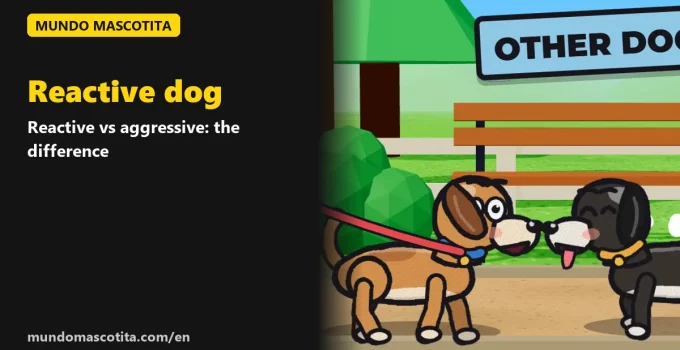
A reactive dog overreacts to everyday things, like other dogs, people or bikes, with barking, lunging or growling, usually out of fear or frustration. Aggression means behavior aimed at threatening or harming. Many reactive dogs don’t want to bite anyone: they want the scary thing to go away, or they can’t handle the excitement.
That difference matters because it changes how you help your dog. This Mundo Mascotita guide on the reactive dog explains what reactivity is, fear vs frustration, why distance is your best tool, the basics of counter-conditioning and when to call a professional.
What reactivity really is
The American Kennel Club describes reactive dogs as dogs that respond to normal, everyday situations with an excessive level of arousal. The reaction is out of proportion to what’s happening. Common signs include:
- Barking, lunging or growling at other dogs, people, bikes, cars or skateboards.
- Pulling hard toward or away from the trigger.
- Staring, freezing or a stiff body before the outburst.
- Whining, spinning or being unable to take treats or listen.
Reactivity often happens on leash or behind a fence or window, and the dog usually calms down once the trigger is gone.
Veterinary behaviorists describe aggression as threatening or harmful behavior, such as growling, snapping or biting, used to avoid a conflict, increase distance or cause harm. The two can overlap. A reactive dog pushed too far, or one that learns that barking makes things go away, can escalate. That’s why reactivity deserves attention, not punishment.
Fear vs frustration
Most reactive dogs fall into one of two groups, and some mix both:
- Fear. The most common cause. The dog feels threatened and tries to make the trigger leave by looking big and loud. Limited socialization as a puppy or a bad experience, such as being attacked by another dog, can play a role.
- Frustration. The dog desperately wants to greet the other dog or person, but the leash or fence stops it. The frustration explodes into barking and lunging. These dogs are often friendly off leash.
The body language is different. A fearful dog may lean back, tuck its tail or try to escape between outbursts. A frustrated dog leans forward and pulls toward the trigger. Telling them apart helps you and your trainer pick the right plan.
Threshold distance
Every reactive dog has a distance at which it can notice a trigger and still stay calm enough to sniff, take a treat and respond to you. Trainers call this being “under threshold.” If the trigger gets closer than that, the dog goes “over threshold” and reacts.
Your dog can’t learn while it’s over threshold. So the first goal is management:
- Walk at quieter times and places.
- Cross the street, turn around or step behind a parked car to add distance.
- Learn your dog’s early warning signs (staring, freezing, ears forward, lip licking) and create distance before the outburst.
- Avoid dog parks and crowded areas while you work on the problem.
Every outburst you prevent is one less rehearsal of the behavior.
Training: counter-conditioning basics
The approach that veterinary behaviorists and the AKC point to is positive-reinforcement training with desensitization (exposure to the trigger at a distance the dog can handle) and counter-conditioning (pairing the trigger with something great, so the dog’s feelings about it change).
- Find a spot where your dog can see the trigger but stays calm.
- The moment your dog notices the trigger, give a high-value treat, such as chicken or cheese.
- When the trigger disappears, the treats stop.
- Repeat many times over days and weeks. Your dog starts to think, “another dog means chicken.”
- Only when your dog is relaxed at that distance, move a little closer.
Teaching a “look at me” cue or a U-turn on cue also gives you an alternative behavior when a trigger appears. There are no quick fixes, and progress comes from consistent practice.
What not to do: don’t yank the leash, shout or use prong, choke or shock collars. Punishment can make fear worse and may suppress warning signals, which makes a bite more likely later.
When to call a professional
Get help if:
- Your dog has bitten or tried to bite.
- Reactivity is getting worse or appears suddenly.
- You can’t safely control your dog on walks.
- Your dog reacts to many different triggers or seems anxious most of the time.
Start with your veterinarian, because pain and other medical problems can change behavior. Then look for a certified behavior consultant, or a board-certified veterinary behaviorist through the American College of Veterinary Behaviorists. A veterinary behaviorist can also assess whether medication could help your dog learn more easily.
FAQ
What is the difference between a reactive dog and an aggressive dog?
A reactive dog overreacts to normal things like other dogs or bikes, usually from fear or frustration, and calms down when the trigger leaves. Aggression is behavior meant to threaten or harm, such as snapping or biting. They can overlap, so take both seriously.
Can a reactive dog be cured?
Many reactive dogs improve a lot with management and positive training such as desensitization and counter-conditioning. Some will always need extra space. Progress depends on the cause, how long the problem has existed and how consistently you train.
Why is my dog only reactive on the leash?
The leash can create frustration in dogs that want to greet others, and it takes away the option to move away for dogs that are afraid. That’s why some dogs are calm off leash but bark and lunge on leash.
Should I punish my dog for barking at other dogs?
No. Punishment can increase fear and suppress warning signals, making bites more likely. Instead, add distance, reward calm behavior and pair other dogs with high-value treats so your dog’s feelings change.
Who should I call for help with a reactive dog?
Start with your veterinarian to rule out pain or illness. Then find a certified behavior consultant or a veterinary behaviorist. Avoid trainers who rely on prong, choke or shock collars.
This guide is part of Mundo Mascotita in English. If your dog has bitten someone, wash the wound with soap and water, seek medical care and contact your veterinarian. Read also: leash pulling and what tail wagging means.
Sources
- American Kennel Club. Reactivity vs. Aggression: What’s the Difference?
- American Kennel Club. How to Stop a Dog From Lunging on a Leash.
- ASPCA. Aggression in Dogs.
- American College of Veterinary Behaviorists. dacvb.org (find a board-certified veterinary behaviorist).


